
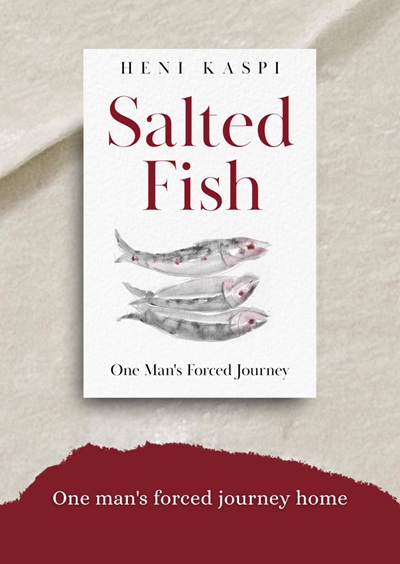
Salted Fish
A Novel of Family, Memory, and Finding Your Way Home
by Heni Kaspi
- Literary Fiction
- Family Drama
The Book
Oren Illouz has built a life far from home: a bistro in Perth, a steady rhythm, the quiet comfort of distance. But when a late-night phone call shatters that peace, he finds himself on a plane back to Israel, drawn by a debt he can no longer ignore and by a father dying on a remote kibbutz in the Negev.
From the moment he lands, urgency closes in. Legal deadlines loom. Old resentments resurface. He drifts between Tel Aviv’s restless street life and the stark isolation of the kibbutz he once fled, unable to settle in either world. Through the unexpected kindness of a small bar owner, Oren meets a lawyer who agrees to represent him for free, a gesture born of shared kibbutz roots. Yet no courtroom can resolve what waits for him at home.
The real battle is within his own family. His mother’s anger remains unspent. His father’s time is running out. And the insular world of the kibbutz, where children slept apart from their parents and learned early to stand alone, still holds its quiet grip on him. Rich in food, music, and tenderness, Salted Fish is a novel about a man in his fifties reckoning with the weight of the past and the unfinished relationships waiting for him at home.
Why This Book Matters
Salted Fish stands where Israeli literary fiction meets the universal story of exile and return. It opens a window onto a world many international readers know only by name, the kibbutz and its children’s houses, where children grew up apart from their parents with fierce loyalty and deep emotional restraint, and shows the long shadow that childhood casts on a grown man.
Heni Kaspi writes in vivid, sensory prose shaped by lived experience. Food is not backdrop but a language of memory and unspoken connection: Hungarian goulash cooked for strangers in a small Tel Aviv bar, the quiet drama of a bistro kitchen in Perth, a salted fish carried across the city for a dying father. Music runs through the novel like a second language, from late-night jazz clubs to two men listening to Weber’s Clarinet Concertino and saying goodbye without a word.
Moving between Perth, Tel Aviv, the Negev, and Paris, the novel balances heartbreak with the bittersweet comedy of one man’s legal battle, offering book clubs rich material on migration, memory, identity, and belonging.
About the Book
Genre: Literary Fiction / Family Drama
Published on May 27, 2025 | 103,300 Words
For admirers of Amos Oz, David Grossman, and Etgar Keret, Salted Fish is an atmospheric novel of exile and return, kibbutz childhood, and the food and music that carry memory.
Author

Heni Kaspi
Heni Kaspi is a restaurateur, jazz saxophonist, and novelist based in Perth, Australia. Born in Israel and raised on Kibbutz Reim in the western Negev, he emigrated to Australia with his wife, Riki, and their two children, building a new life between languages and cultures, an experience that continues to shape his writing.
Together they ran a successful bistro before expanding into a cooking school, and Kaspi’s intimate knowledge of restaurant life, from the rhythm of small kitchens to the exhaustion and pride of building something from nothing, runs deep through Salted Fish. A lifelong musician who moved from clarinet to saxophone, he spent years playing jazz in small clubs.
His lyrical, atmospheric style draws on the philosophical tradition of Albert Camus, whose work he discovered as a mature-age student at the University of Western Australia. Like his protagonist, Kaspi knows firsthand what it means to grow up on a kibbutz and to build a life on the other side of the world.
Rights Status
Publishing Rights Available
Translation Rights Available
Film Rights Available
Audio Rights Available
Comparable Titles
This book is suitable for readers who enjoyed:
- Between Friends by Amos Oz
- To the End of the Land by David Grossman
- The Seven Good Years by Etgar Keret
BISAC Categories
- FIC019000 – FICTION / Literary
- FIC045000 – FICTION / Family Life / General
- FIC051000 – FICTION / Cultural Heritage
Themes
- Exile, Homecoming, and Belonging
- Fathers and Sons, Mothers and Unspent Anger
- Kibbutz Childhood and Emotional Restraint
- Food as a Language of Memory
- Music as Unspoken Connection
- Debts, Financial and Emotional
- Shame, Memory, and Longing
- Saying Goodbye
Keywords
For readers interested in:
- Contemporary literary fiction
- Stories of exile, migration, and return
- Israeli fiction and kibbutz life
- Father-son and family relationships
- Novels about food, cooking, and restaurant life
- Jazz and music in fiction
- Atmospheric, character-driven novels
- Book club fiction on memory and identity
FAQ
Where does the story take place?
Between Perth, Tel Aviv, a kibbutz in the Negev desert, and Paris.
Who is the main character?
Oren Illouz, an Israeli restaurateur in his fifties living in Perth, who is called home by a debt and by his dying father.
Is the book autobiographical?
It is a novel, but it draws on the author’s own life: a kibbutz childhood in the Negev, emigration to Australia, years of running a bistro, and a lifelong love of jazz.
Has this book been published before?
Yes, the book is published in English.
Who will enjoy this book?
Readers of contemporary literary fiction, admirers of Amos Oz, David Grossman, and Etgar Keret, readers drawn to novels where food and music shape emotional life, and book clubs interested in migration, memory, and belonging.
Rights Agent's Notes
Salted Fish offers publishers a literary novel with a strong sense of place and a perspective rarely seen in translation: the kibbutz childhood and its lifelong emotional legacy, seen through the eyes of a man who left. Its themes of exile, return, and family reckoning travel easily across markets, and its food and music give it a sensory, distinctive identity.
Readers have responded strongly to the English edition. One Amazon reviewer described it as lingering “like a jazz solo played at dusk: soulful, fractured, and wholly human.” The author’s own story, from Kibbutz Reim to a restaurant and cooking school in Perth, adds a compelling publicity angle.