
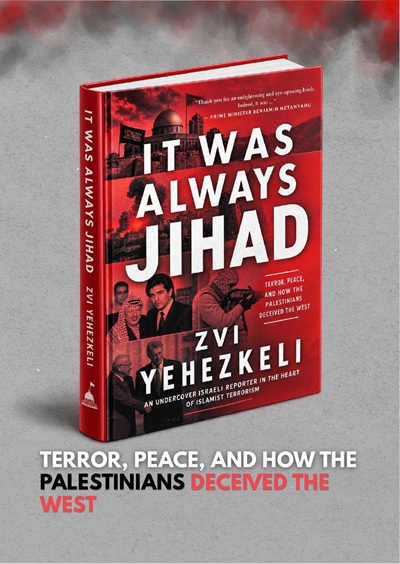
It Was Always Jihad
Terror, Peace, and How the Palestinians Deceived the West
by Zvi Yehezkeli
- Nonfiction
- Current Affairs
- Middle East
- Memoir & Investigative Journalism
The Book
There is one thing the liberal West keeps missing about the Palestinian struggle, argues Zvi Yehezkeli: it has always been, and remains today, first and foremost a jihad. After three decades spent undercover inside extremist groups, serving in the Shin Bet, and reporting from the front lines of the Middle East, one of Israel’s most prominent Arab affairs correspondents sets out to explain the conflict as he has seen it from the inside.
Drawing on direct interviews with Yasser Arafat, Zakaria Zubeidi, Hassan Nasrallah, Yahya Sinwar, and many other militant leaders, Yehezkeli argues that Palestinian leadership from Arafat to Abbas never abandoned the goal of Israel’s eradication. Instead, he contends, it turned Western liberal values such as freedom of movement, multiculturalism, and civil rights into tools of what he calls “The Quiet Jihad”: a dual-track strategy that pairs diplomatic legitimacy with incitement, military buildup, and terror.
Across fourteen chapters, the book moves from Yehezkeli’s childhood in pre-Intifada Jerusalem, through his years in the Shin Bet and three decades in television journalism, to undercover operations such as infiltrating Jericho Prison with a hidden camera to interview the assassins of Tourism Minister Rehavam Ze’evi. It ends with an examination of the October 7 intelligence failure and the author’s own journey back to Judaism.
Why This Book Matters
October 7, 2023 forced Western governments, intelligence services, and media to ask how they misread the Middle East so badly. Readers are now looking for insider accounts that explain what was missed. It Was Always Jihad offers one from an author with an unusual combination of credentials: former Shin Bet undercover operative, veteran head of the Arab Affairs Desk at Channel 13 News, and maker of undercover documentaries inside extremist networks in Europe and the Middle East.
The book reads like a narrative of espionage and front-line reporting, built on vivid first-hand scenes: Arafat in the besieged Muqata’a, Zubeidi firing a rifle over the author’s head, the 2018 Sayeret Matkal incident that drove Hamas off cellular networks. At the same time, it lays out clear analytical frameworks, including “The Hudaybiyyah Model” of ceasefires as tactical pauses and the “SIGINT over HUMINT” trap that left intelligence blind to human intent.
That mix gives the book reach across several audiences: security and policy professionals, journalists and media critics, readers of espionage and true-story narratives, and general readers trying to understand the post-October 7 Middle East.
About the Book
Genre: Nonfiction / Current Affairs / Middle East / Memoir & Investigative Journalism
Not Published Yet | 138,100 Words
For readers of Ari Shavit’s My Promised Land and Bryan Burrough’s Days of Rage, It Was Always Jihad is an insider’s account of the Arab-Israeli conflict from one of Israel’s most prominent Arab affairs correspondents.
Author

Zvi Yehezkeli
Zvi Yehezkeli is an Israeli journalist and author, born in Jerusalem in 1970. He holds a Master’s degree in Middle Eastern Studies from the Hebrew University of Jerusalem and studied at the Koteret School of Journalism at Tel Aviv University. He served in the IDF Special Forces as an undercover combat soldier and spent seven years in the Shin Bet (Israel Security Agency) as an undercover operative and security analyst.
He then built a 30-year career in journalism, from Galei Tzahal (IDF Radio) to head of the Arab Affairs Desk at Channel 13 News. He has made a series of award-winning undercover documentaries on radical Islam in Europe and the Middle East, including Allah Islam (2012), Hijra (2015), Confessions from ISIS (2017), and Salam Iran (2020). Today he is a senior commentator and host of The Arabists on i24NEWS.
Fluent in Arabic, Yehezkeli once lived disguised as a Palestinian in Hebron and Nablus to master the language and its cultural codes. He has interviewed Yasser Arafat eight times and reported from inside besieged compounds during major escalations, experience that gives the book its first-hand authority.
Rights Status
Publishing Rights Available
Translation Rights Available
Audio Rights Available
Comparable Titles
This book is suitable for readers who enjoyed:
- My Promised Land by Ari Shavit
- Days of Rage by Bryan Burrough
- Spin Masters by Yinon Magal and Kobi Meidan
BISAC Categories
- POL037000 – POLITICAL SCIENCE / Terrorism
- POL036000 – POLITICAL SCIENCE / Intelligence & Espionage
- HIS026000 – HISTORY / Middle East / General
- BIO025000 – BIOGRAPHY & AUTOBIOGRAPHY / Editors, Journalists, Publishers
Themes
- Western Assumptions vs. Middle Eastern Realities
- Peace Agreements as Tactical Pauses (The Hudaybiyyah Model)
- “The Quiet Jihad” and “Intifada in a Suit”
- Technology vs. Human Intelligence (SIGINT over HUMINT)
- The Roots of the October 7 Intelligence Failure
- Undercover Journalism and Espionage
- Friendship and Enmity in Jerusalem
- Identity, Faith, and National Survival
Keywords
For readers interested in:
- The Israeli-Palestinian conflict and October 7
- Middle East politics and terrorism
- Intelligence, espionage, and security services
- Undercover and investigative journalism
- Insider accounts of Arafat, Hamas, and Hezbollah
- Political Islam in the Middle East and Europe
- Memoirs of journalists and war correspondents
- Geopolitics and national security
FAQ
What is the book’s central argument?
That Western governments and intelligence services projected their own assumptions onto the Middle East, and that Palestinian leadership used peace processes and Western values tactically while never abandoning its goals.
Is the book based on first-hand experience?
Yes. It draws on the author’s years in the Shin Bet, three decades as an Arab affairs correspondent, undercover documentaries, and direct interviews with leaders including Arafat, Zubeidi, Nasrallah, and Sinwar.
Does the book cover October 7?
Yes. Its final chapters examine the roots of the October 7 intelligence failure and the war that followed.
Has this book been published before?
No, this book has not been published yet.
What is the word count?
138,100 words.
Who will enjoy this book?
Security and policy professionals, journalists, students of Middle Eastern and security studies, readers of espionage and true-story narratives, and anyone seeking an insider’s view of the post-October 7 Middle East.
FAQ
What is the book’s central argument?
That Western governments and intelligence services projected their own assumptions onto the Middle East, and that Palestinian leadership used peace processes and Western values tactically while never abandoning its goals.
Is the book based on first-hand experience?
Yes. It draws on the author’s years in the Shin Bet, three decades as an Arab affairs correspondent, undercover documentaries, and direct interviews with leaders including Arafat, Zubeidi, Nasrallah, and Sinwar.
Does the book cover October 7?
Yes. Its final chapters examine the roots of the October 7 intelligence failure and the war that followed.
Has this book been published before?
No.
Who will enjoy this book?
Security and policy professionals, journalists, students of Middle Eastern and security studies, readers of espionage and true-story narratives, and anyone seeking an insider’s view of the post-October 7 Middle East.
Rights Agent's Notes
It Was Always Jihad arrives as publishers and readers continue to look for books that explain October 7 and its aftermath. Zvi Yehezkeli brings rare credibility to that conversation: years as a Shin Bet undercover operative, three decades as a leading Arab affairs correspondent on Israeli prime-time news, and a body of award-winning undercover documentaries. He is also a recognized television personality who can support publicity.
The book combines the pace of an espionage narrative with direct access to figures such as Arafat, Zubeidi, and Sinwar, giving it appeal beyond the current-affairs shelf. We see strong potential in English-language markets (US, UK, Canada, Australia) and in European markets such as France, Germany, and the Netherlands, where debates on political Islam and security are especially active.