
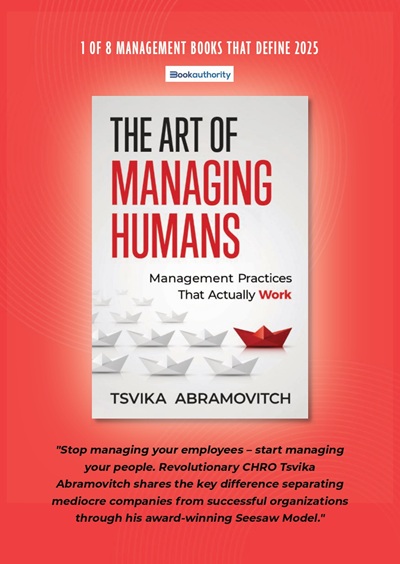
The Art of Managing Humans
Management Practices that Actually Work
Tsvika Abramovitch
- Self-Help, Business
- Nonfiction
- HR & Management
- Leadership
The Book
The Art of Managing Humans: Management Practices that Actually Work is a practical, experience-driven guide to the complexities of modern organizational life. Its starting point is simple: business comes down to “people, product, and profits,” and people come first. Successful management, author Tsvika Abramovitch argues, fundamentally revolves around nurturing the relationship between employees and leadership.
The book is built around the Seesaw Model, a framework Abramovitch developed over more than three decades as a Chief Human Resources Officer at leading Israeli corporations. The model was born in the field, not in academia, and offers a practical way to manage employees. Working relationships are dynamic and constantly in motion, like a seesaw. Balance comes not from ignoring the swings, but from steady investment in transparency, employee involvement, development and attentiveness.
The book walks leaders through six stages: mapping strengths and weaknesses, in-depth assessment, analysis of findings, outdoor events and “smart games,” follow-up processes and work plans, and finally “fruit-bearing” investment in people. It also sets the model against the dramatic changes in the workplace over recent decades, from the submissive, lifelong employee of the 1950s–80s to today’s knowledgeable workforce, and the “revolution” brought on by the pandemic and remote work.
Why This Book Matters
- A model from the field, not the lab. The Seesaw Model grew out of decades of HR practice. It has already been applied in hundreds of organizations worldwide and bridges academic theory with practical implementation.
- From “work relations” to “working relationships.” The book replaces a legal, transactional view of the workplace with one centered on culture, dialogue, growth and trust.
- Timely for the post-pandemic era. It addresses “organizational distancing” and explains how to rebuild connection, culture, evaluation and recruitment in partly or fully remote organizations.
- Loyalty is redefined. Modern employees commit “as long as I work here, but not at any cost,” and direct managers are the single strongest influence on that commitment.
- Concrete tools. Focused listening, roundtable discussions, “freestyle field trips,” experiential outdoor games, and unbiased talent screening (illustrated by the Atudot leadership-pipeline project, which surfaced hidden high-potential employees).
- A look ahead. As knowledge and data tools become widely accessible, tomorrow’s leaders will be judged less on technical expertise and more on their ability to lead, motivate and build trust.
- Named one of “8 New Management Books That Define 2025” by BookAuthority, and a Difference Maker Awardee at Store with a Heart.
About the Book
Genre: Nonfiction / Business / HR & Management / Leadership
English edition published | 52,000 words
A practical, mentor-like management book that sits comfortably beside Leaders Eat Last, with an Israeli lens and case-based authenticity (The Chrysalis BREW Project)
Author

Tsvika Abramovitch
Abramovitch is an international HR management expert with more than 30 years of experience as Chief Human Resources Officer at major Israeli corporations, including Pelephone, Tnuva and Bezeq International. He is the recipient of the prestigious STEVIE Award for HR Executive of the Year and two HR Excellence Awards, and has consulted hundreds of organizations worldwide.
Abramovitch is the creator of the award-winning Seesaw Model, a framework for building stable, productive relationships between employees and management that has been applied in hundreds of organizations around the world.
Rights Status
Publishing Rights Available excluding Indian sub-continent and Hebrew
Translation Rights Available
Film Rights Available
Audio Rights Available
Comparable Titles
This book is suitable for readers who enjoyed:
- Leaders Eat Last by Simon Sinek
BISAC Categories
- BUS071000 – Business & Economics / Leadership
- BUS030000 – Business & Economics / Human Resources & Personnel Management
- BUS085000 – Business & Economics / Organizational Behavior
Themes
- Building working relationships rather than work relations
- Balance as a constant, dynamic process (the Seesaw Model)
- Transparency and employee involvement in times of change
- Redefining loyalty and commitment in the modern workplace
- Leadership through listening, trust and emotional intelligence
- HR as a true business partner and human capital as a competitive advantage
- Breaking down management silos and aligning incentives with company goals
- Organizational culture and “organizational distancing” in the remote-work era
- Unbiased talent discovery and leadership pipelines
- Genuine investment in employees’ development and wellbeing
Keywords
- HR management book
- Seesaw Model
- employee engagement
- leadership development
- organizational culture
- remote work and hybrid teams
- people management
- executive and MBA education
- corporate training
- organizational change
FAQ
What is The Art of Managing Humans about? It is a practical management and HR guide centered on the Seesaw Model, a six-stage framework for building and sustaining balanced, trust-based relationships between employees and leadership.
Who is Tsvika Abramovitch? An international HR expert with 30+ years as CHRO at companies including Pelephone, Tnuva and Bezeq International. He is a STEVIE Award winner for HR Executive of the Year and has consulted hundreds of organizations worldwide.
What is the Seesaw Model? A framework developed from the author’s fieldwork. It treats workplace relationships as dynamic, always in motion, and keeps them stable through continuous investment in transparency, involvement, development and attentiveness.
What are the six stages of the model? Mapping strengths and weaknesses; in-depth assessment; analysis of findings; outdoor events/smart games; processes following assessment and work plans; and fruit-bearing investment.
How long is the book? 52,000 words.
Who is it for? Executives, HR professionals, senior managers, team leaders, organizational consultants, and MBA and corporate-training programs.
Is it academic or practical? Practical. It is grounded in decades of real-world experience while bridging academic theory and implementation.
Rights Agent's Notes
The Art of Managing Humans is a strong fit for business, management and HR publishers. It combines a distinctive, proprietary framework with three decades of senior executive experience and third-party recognition (a BookAuthority 2025 listing, a STEVIE-winning author, and multiple positive reviews). Demand for leadership transformation is growing worldwide in the post-pandemic era, and the book has clear secondary potential as a text for MBA programs, corporate training departments and organizational development consultants.
Its Israeli lens and case-based approach add a fresh perspective to a market dominated by American management titles.