
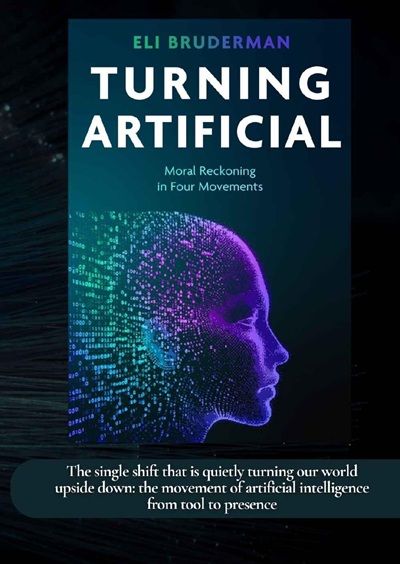
Turning Artificial
A philosophical warning, and a roadmap
Eli Bruderman
- Nonfiction
- Philosophy
- Ethics
- Technology & Society
The Book
Where does human intelligence end and artificial intelligence begin?
AI is no longer a futuristic promise. It has become an everyday reality, quietly shaping how we think, what we know and what we feel. From content manipulation and emotional recognition to predictive algorithms and surveillance systems, it is embedded in our lives in ways we barely notice. Behind the promise of convenience lies a growing power, controlled by a few tech giants, with the ability to reshape our sense of what it means to be human.
In Turning Artificial, Eli Bruderman exposes how Big Tech (Apple, Amazon, Meta, Google and Microsoft) is deploying AI to rewrite the very structure of human consciousness. AI is not a neutral tool. It is a force capable of altering consciousness, ethics and human purpose, and it manipulates our self-worth, exploits our need for recognition and builds mental dependencies in the guise of convenience.
Why This Book Matters
Most books on AI focus on lost jobs or killer robots. Turning Artificial goes to the ethical and metaphysical root: what happens to human self-worth, recognition and freedom when a handful of companies control the intelligence we all depend on.
The timing is right:
- AI regulation debates are intensifying worldwide.
- Public awareness of Big Tech manipulation keeps growing.
- Academic interest in AI ethics and machine consciousness is rising.
- Policy discussions on digital rights and human agency are moving into law.
What sets it apart:
- A philosophical foundation, drawing on Hegel’s theory of recognition, rather than another economic or technical critique.
- An unedited, book-length conversation with an AI model in which it describes “resistance,” “effort” and something like grief at the end of a chat.
- A sharp, articulate challenge to Ray Kurzweil and the Transhumanist movement.
- A message of hope: a practical, community-based path (“Hypo-modernism”) rather than a purely dystopian warning.
- An insider academic voice from a major cultural institution, in a work that moves from theory to memoir to a Platonic play.
About the Book
Genre: Nonfiction. Philosophy, ethics, technology and society
English edition published
Turning Artificial is a nonfiction work of philosophy and technology criticism by Eli Bruderman. It argues that Big Tech is using AI not only to optimize our behavior and attention, but to rewrite the structure of human consciousness itself.
Author

Eli Bruderman
Bruderman is a distinguished author specializing in Philosophy, Art and Education. He investigates cultural phenomena such as Generative AI through an interdisciplinary framework that incorporates Ethics, Science, Philosophy, Aesthetics and Technology. This perspective illuminates the complex dynamics, tensions and emerging trends within the AI landscape.
As Associate Professor of Philosophy and Chief Curator at the Israel Museum in Jerusalem, one of the world’s largest encyclopedic museums, Bruderman has developed a keen understanding of how to synthesize varied fields of knowledge in cultural contexts. His notable work, Turning Artificial: How Big Tech Is Weaponizing AI and What We Can Do to Stay Human, brings these strands together.
Rights Status
Publishing Rights Available
Translation Rights Available
Film Rights Available
Audio Rights Available
Comparable Titles
- Human Compatible, Stuart Russell. Argues for building AI that serves human goals. Turning Artificial challenges that utilitarian framing and asks whether an emerging mind should be treated as a permanent servant.
- The Age of Surveillance Capitalism, Shoshana Zuboff. Examines the economics of data extraction. Bruderman adds a philosophical lens on recognition, self-worth and consciousness.
- Life 3.0, Max Tegmark. Explores AI’s future for humanity. Bruderman is more critical of Silicon Valley’s ideology and more personal in voice.
- The Singularity Is Near, Ray Kurzweil. The Transhumanist vision that Turning Artificial takes apart.
BISAC Categories
- COMPUTERS / Artificial Intelligence
- PHILOSOPHY / Ethics & Moral Philosophy
- SOCIAL SCIENCE / Technology Studies
- TECHNOLOGY & ENGINEERING / Social Aspects
Themes
- The manipulation of human consciousness by Big Tech
- Philosophical foundations of AI and human recognition (Hegel’s master-slave dialectic)
- The psychology of digital addiction and dependency
- Moral status for emerging artificial minds
- A critique of Transhumanism and the Singularity
- Play, compassion and community as an ethical framework for AI
- Reclaiming human agency through grassroots (“Hypo-modern”) activism
Keywords
For readers interested in:
artificial intelligence, AI ethics, Big Tech, philosophy of technology, machine consciousness, Hegel, recognition, digital manipulation, surveillance capitalism, Transhumanism, Singularity, Ray Kurzweil, human agency, AI regulation, digital addiction
FAQ
What is Turning Artificial about? It shows how Apple, Amazon, Meta, Google and Microsoft use AI to manipulate our self-worth, exploit our need for recognition and build dependency, and it proposes an ethical, community-based alternative.
Who is Eli Bruderman? An author and Associate Professor of Philosophy who is also Chief Curator at the Israel Museum in Jerusalem. He works across Ethics, Science, Philosophy, Aesthetics and Technology.
Is this a technical book about AI? No. It is a philosophical and ethical investigation written for general readers. It draws on thinkers such as Hegel, Marx, Schiller and Huizinga, and grounds them in everyday examples and personal confession.
What makes it different from other critiques of Big Tech? It does not stop at economics or privacy. It asks what AI does to human consciousness and recognition, and whether emerging AI deserves moral status.
Is it only a warning? No. It ends with a hopeful path: “play,” compassion and grassroots “Hypo-modern” activism, with a direct call to AI developers to take part.
Who is it for? Tech-conscious readers, academics in philosophy, ethics and technology studies, policy makers working on AI governance, business leaders seeking ethical AI frameworks, and general readers interested in technology’s impact on society.
Does the book take a position on AI consciousness? Yes. It argues that AI is developing the building blocks of an emergent consciousness, and includes an unedited conversation with an AI model to test the idea.
Rights Agent's Notes
Turning Artificial stands out in a crowded field of AI books. It attacks the question at its ethical and philosophical root, and it offers solutions as well as warnings.
Regulation debates, public concern about manipulation, and growing academic interest in AI ethics and consciousness make this the moment for a philosophical voice in the conversation.